important He can build giant bridges from iron. He can make the Earth's tallest 300-meter Eiffel Tower by joining 18,000 iron pieces like a puzzle. He can also design an iron frame on which a 151-feet-tall statue of Liberty stands for about 136 years. Then what do you call him? ……………………
A Magician of Iron, right? That’s why we call him, and his name is Gustave Eiffel.
Let’s learn who and explore his inspiring journey through life.

Gustave Eiffel was a French Civil Engineer by Field ( especially structural engineering- A branch of civil Eng.), an Entrepreneur (started his own company, Eiffel et Cie in 1866), and a Metal Expert by Skill (especially in wrought Iron for large structures).
He designed and built iron bridges, railway stations, and the iconic Eiffel Tower using advanced metal engineering techniques.
He was famous in Europe for making spectacular bridges. His innovations and uniqueness in metal construction are revolutionary and charismatic. I can say he was a genius who understand how to use the power of iron in making of sophisticated infrasturcture like bridge, railway station etc .
important Gustave Eiffel was a Chemical Engineer by Degree
Gustave Early Life
Gustave Eiffel was born on December 15, 1832, in Dijon, a city located in the Burgundy (Bourgogne) region of France. The distance from Paris to Dijon is 310 kilometers.
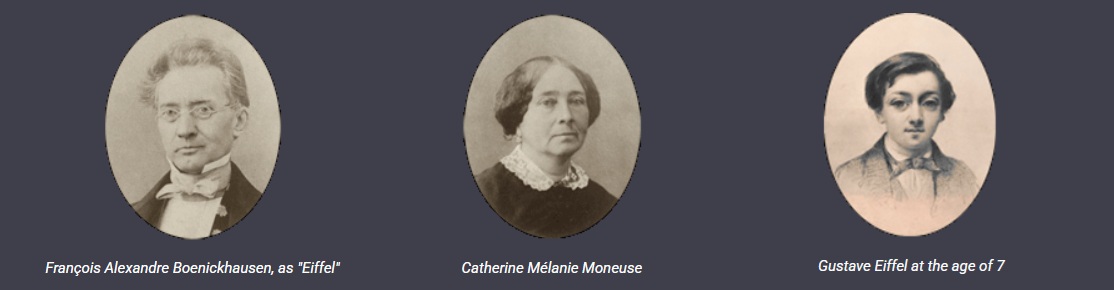
He belonged to a middle-class family. Gustave Eiffel’s father was François Alexandre Eiffel, who was an ex-soldier served in the Napoleonic armies and later worked as a military administrator. After that, he worked in woodcraft for some time, then joined the coal business. Gustave’s mother, Catherine-Mélanie, came from a business family. Her father had started a coal-distribution business factory, and later she took charge of it. This factory became the main source of income for the family.
Jean-Baptiste Mollerat, Gustave Eiffel’s maternal uncle, had developed a method for making distilled vinegar and ran a chemical factory near Dijon. Along with his friend, the chemist Michel Perret, he spent a lot of time with young Eiffel, introducing him to subjects like chemistry, mining, theology, and philosophy.
important Vinegar is a sour liquid made from the fermentation of alcohol, commonly used in cooking, preserving food, and sometimes cleaning.
Eiffel’s father was mostly involved in business, so he did not have much time for Gustave's education. But his mother Catherine, cares so much about his career and life. She was a hardworking and very disciplined woman. She not only successfully manages his family's vinegar business, but also looks after Gustave's education meticulously. She always encourages him to study well, think big. She has believed in him. Her support, careful shaping of his life are the result of Gustave's success. So yes, credit is due to his mother. Truly, we can say she was really the Iron Lady.
important A Sad Story-Gustave Eiffel’s mother, Catherine-Mélanie, had five children. But only Gustave survived and reached adulthood. His other brothers and sisters died at a young age, which was sadly common in the 1800s because medical help was not so good at that time.
Graduated in chemistry (Chemical Engineering)
As Gustave grew older, he became more and more interested in science and how things work. He decided to study engineering.
He graduated in chemistry (Chemical Engineering ) from School École Centrale des Arts et Manufactures, Paris in 1855.
In college, Gustave Eiffel mostly studied chemistry. But after completing his studies and starting work, he slowly got more interested in metals, especially iron. By working on real projects, he saw how strong iron can be for building big structures like bridges and towers. That’s how his journey with iron truly began.
important École Centrale des Arts et Manufactures- The school where Gustave Eiffel studied became CentraleSupélec, part of the University of Paris-Saclay in 2015. In Eiffel’s time, it was in central Paris (rue Montgolfier, 3rd arrondissement) , but in 2017, the school moved to Gif-sur-Yvette, outside the city
Starting a career as a project assistant
In 1856, one year after college, Gustave Eiffel got his first job at a company called Société des établissements Cail. There, he started his career as a junior project assistant under the experienced engineer Charles Nepveu.
At this job, Mr. Eiffel worked on railway bridge projects. He learned how to design and build iron structures, handle metal parts, and understand construction methods used in real-world engineering. He also saw how large metal parts are planned, measured, and put together on site.
Charles Nepveu, his Master, was not only skilled but also a great guide. He gave Eiffel chances to work closely on technical tasks and understand project planning. Nepveu noticed Eiffel’s talent and dedication. Later, when Nepveu joined a new company, Compagnie Belge de Matériels de Chemin de Fer, he took Eiffel along with him.
During the early days of his job (1856–1860), Eiffel not only learned but also made a strong impact. He worked directly on bridge construction sites and made sure that every iron part was placed correctly and safely. He learned how iron reacts -how it bends, expands, and holds weight. He also solved many technical problems like fitting errors or small structure fixes.
Slowly, people started to notice his focus and accuracy. It became a saying that if a project is under the Eiffel, it will surely be successful.
Career as an Entrepreneur (Constructor)
In 1866, Mr. Effel started his own company, Eiffel et Cie, based in Levallois-Perret (outside of Paris), mainly focused on metal Bridges in wrought iron. By 1868-1875, earned a reputation for precision and innovation. With his company, he constructed railway bridges, including the 305-meter-long wrought iron arch bridge Maria Pia Bridge on the river Douro in Portugal (1877), with engineer Théophile Seyrig.
in 1879, he changed his company name, Compagnie des Établissements Eiffel now focus on international projects. he taking major international project like taking on a major international project like
Framework for the Statue of Liberty (USA). Various buildings and bridges across Europe, Latin America, and Asia. After the Panama scandal in 1893, he left the company, but the name Eiffel was already famous across the world.
Research Work
After retiring from construction work , Eiffel focused on scientific research, especially aerodynamics.
He built a wind tunnel near the Eiffel Tower and later a bigger one in Auteuil, Paris.
There, he studied how air moves around objects, which helped improve early airplane designs. His work supported the rise of aviation and made him a respected scientist, too.
Personal Life
Eiffel lived a simple, private life. Mr Eiffel married to Marguerite Gaudelet in 1862 and had five children.
He remained close to his family and preferred to stay out of the spotlight. Despite building one of the most famous structures in the world, he stayed humble and focused on work and science.
important Sad Story Again-- Gustave Eiffel’s wife, Marie Gaudelet, died young in 1877 at the age of 32 just after 15 years of marriage, leaving Eiffel to raise their five children alone. Her early death deeply affected him, and he never remarried.
Achievements
The biggest achievement of Gustave Eiffel’s life was the making of the Eiffel Tower, which, during his time, became the tallest structure on Earth. It held that title for 41 years, until the Chrysler Building (319 meters) in New York City was completed in 1930. Sadly, Eiffel passed away in 1923, before he could witness this moment of global recognition. Throughout his career,He contributed to 100+ projects, including bridges, railway stations, and iron frameworks (notably the Statue of Liberty)., mostly in Europe.
- Eiffel Tower (1889) - Designed and built the world’s tallest structure at that time, now a global symbol of Paris.
- Statue of Liberty’s Iron Framework (USA, 1886) - Created the internal support structure for this famous American statue.
- Garabit Viaduct (France) - Built one of the highest railway bridges of its time using a strong iron arch.
- Railway Bridges Across the World - Designed and built bridges in Europe, Asia, and South America.
- Started His Own Company (1866) - Founded Eiffel et Cie, which became world-famous for metal construction.
- Innovator in Iron Construction - Used lattice iron designs to make buildings stronger and lighter.
- Helped Science - After retirement, he worked in meteorology and aerodynamics to support future engineers.
Panama Canal Controversy
What Happened:
In 1887, Gustave Eiffel was hired for the Panama Canal project after the original sea-level canal plan was already failing. The canal was initially planned without locks (sea-level). When this proved impossible due to technical and geographic issues, Eiffel was invited to design a system of locks and gates as an alternative.
The main project was run by Ferdinand de Lesseps, the same man who made the Suez Canal. he was was overly ambitious and poorly managed.
The Scandal:
In 1889, the company failed and went bankrupt. Many investors lost their money, and a big scandal started in France.
Eiffel, although not responsible for the financial mismanagement, was dragged into the legal case because of his high-profile name.
In 1893, he was convicted and sentenced to 2 years in prison and a fine, but later that same year the verdict was overturned and he was cleared of all charges.
Result:
This incident damaged his public image temporarily.. After this, Eiffel left commercial work and focused on science. He started doing research in wind, weather, and aerodynamics.
So it was not Eiffel's fault; he was part of the project, but only as an engineer.
Eiffel's Legacy
Remember for making a symbol of Peris Eiffel Tower
Gustave Eiffel made history by building structures that were both strong and beautiful: The Eiffel Tower, built in 1889 for the World Fair in Paris, became a global icon.
Innovative idea in the Iron framework and Bridges
He is remembered for his innovative ideas in building bridges and structures. Unlike the old method of using stone, he used iron frameworks in a triangular lattice design, which made them stronger and cheaper than traditional bridges.
Man with an Iron Heart
Eiffel faced many challenges in both his professional and personal life. He lost his beloved wife at a young age, which left a deep pain in his heart. He kept his pain inside and never let it stop his work.
He faced criticism and personal attacks while building the Eiffel Tower. They called him bizarre and mercantile imaginings of a machine builder, but he never gave up.
His focus, hard work, and belief in engineering and science made him a man with an iron heart - strong, calm, and unshakable.
Gustave Eiffel in France Today
Today in France, Gustave Eiffel is a very respected name. His name lives with the people of France through the Eiffel Tower, a proud symbol of Paris. Many streets, bridges, and engineering institutions in France are named after him. His innovative thinking and futuristic idea of iron work is taught in engineering classes, and his legacy continues to inspire architects, scientists. Eiffel is not just remembered as a builder, but as a visionary scientist who saw the strength in iron and shaped it into history
He died on December 27, 1923, at the age of 91…………………………..
important Mr. Gustave Eiffel - the man who dared to dream in iron and left behind a symbol of strength, beauty, and human spirit. He proved himself in every way - a true man, both in personal life and professional work. He was the Constructor.
important QF.Biography is a branch of Queryflag. We research and write about people who changed the world with their work and ideas.