Joseph Pulitzer was an American journalist and politician, and one of the most prominent figures in the world of journalism. The most famous honor, the Pulitzer Prize in the field of journalism, is named after him.
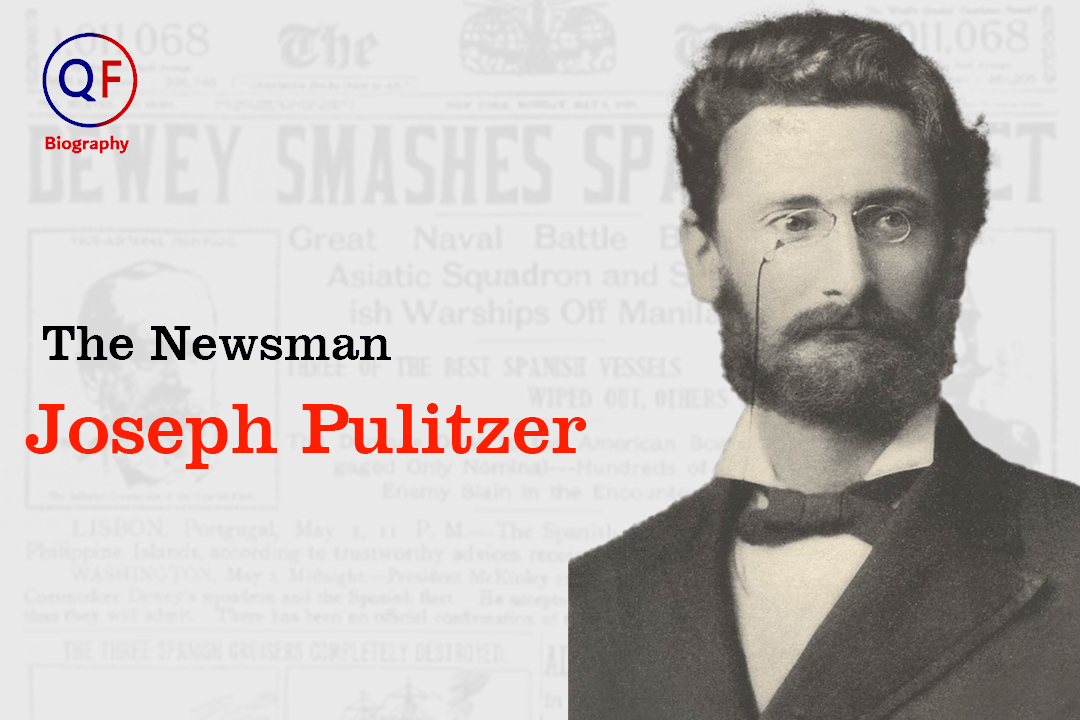
important A 17-year-old Hungarian boy who wants to join the army but he rejected for every time, then with great hope, he came to America as an immigrant soldier with no money, no knowledge of English, and no clear future. Yet, through sheer dedication, relentless drive, and fearless ambition, he rose to become a giant in American media, and he is the man who changed journalism forever.
Let’s Know His Journey from Obscurity to Becoming a Newsman in America.
Early Life
Joseph Pulitzer was born on April 10, 1847, in the town of Makó, about 200 kilometers away from the capital, Budapest. His father, Philip Pulitzer, was a respected grain businessman in the city. His mother's name was Elize Berger.
Joseph had eight brothers and a sister, and was the third child among them. Joseph also had poor eyesight and fragile health from a young age.
In 1853, the family moved to Pest (part of modern-day Budapest), where Joseph received his education from private tutors. While studying in Budapest, he learned French and German, but he didn’t know English.
In 1858, when Joseph was just 11 years old, his father passed away. This is the beginning of his life's struggle. The family broke apart, the business collapsed, and after a few years, his mother remarried. His relationship with his stepfather worsened day by day.
Want to join the Army
Since childhood, Joseph had weak eyesight, but he also had a strong willpower and determination to achieve something in life. As he grew older, he applied to join the Austrian Army and the French Foreign Legion, including in Hungary, but he was rejected everywhere on medical grounds. However, he did not give up.
Eventually, in at the age of 17, he migrated to America, where he joined the Union Army during the Civil War. And thus, Joseph began his military career in the United States.
Come to America as an Immigrant soldier
He came to America as an immigrant soldier. In 1864, at the age of 17, he joined the Union Army during the American Civil War.
During the American Civil War, some recruiters in Germany promised Joseph Pulitzer that they would cover his travel expenses to America and also give him a bounty for enlisting in Boston. Pulitzer accepted the offer and came to the United States.
However, he soon discovered that he had been given only a small portion of the promised bounty, as the recruiters had kept most of it for themselves. After realizing this, he moved to New York and enlisted in the Union Army’s Lincoln Cavalry.
The Lincoln Cavalry was often involved in scouting missions, picket duty, and protecting supply routes during the Civil War. Pulitzer likely performed such basic military tasks.
he served for eight months in military service. His service in the army was short and unremarkable, due to his poor health, and he still didn’t speak English fluently.
Joseph's Life After the American Civil War
After the war in 1865, Joseph was now 18 years old with a little money, some memories, no one who knew him, and no family to ask about him. He had one thing: goodness, life lessons, and an anger to do something. So in search of opportunity, he looked inNewyork, Philadelphia, and Boston, but did not find success. Then he heard from a German recruiter in Missouri that there were many German immigrants in St. Louis and good job opportunities there. Joseph Pulitzer reached St. Louis in 1965, and from here began the story of becoming the great Joseph Pulitzer.
From 1865 to 1868, 3 years of his life were full of struggle. He did jobs like loading and unloading cargo, grave digging, mule tending, and working as a waiter. He often slept in parks or cheap lodging houses. Due to his poor English, he faced many difficulties in getting a job. But Joseph, full of strong willpower, was not someone who would stop. He used to go to the St. Louis Mercantile Library and study English there. Within just a few years, he became excellent in English. He read a lot of books on Law, History, philosophy, and politics at the Mercantile Library. He also became familiar with America's civic system. Then in 1868, Pulitzer joined the German newspaper Westliche Post as a reporter, which was a German newspaper, and in this way, Pulitzer's career as a journalist began.
Enter in Journalism as a Reporter
Joseph Pulitzer did not become a journalist through some grand plan it was a result of both chance and perseverance.
When he arrived in St. Louis, he was simply searching for better job opportunities and a more stable future. To achieve this, he began learning English and regularly studied at the Mercantile Library to educate himself in law, politics, philosophy, and history.
During this time, he found work in a Law Office as a clerk, where his duties involved copying contracts, organizing court filings, and managing legal correspondence. Although the pay was very low, the experience he got was invaluable. He gained a deep understanding of the American legal system, learned formal English and legal vocabulary, and interacted with lawyers, politicians, and civic officials.
This exposure developed in him a strong sense of research, logic, and analytical thinking, along with a passion for justice and reform all of which would later become the foundation of his journalistic voice.
While studying at the library, he frequently engaged in discussions with intellectuals and reformist thinkers, and his thoughts on justice and change left a mark on those around him.
It is believed that one of those individuals may have recommended him for a reporting position at the German-language newspaper Westliche Post.
And in 1968, one day, he received an offer from Westliche Post, and this marked the beginning of Joseph Pulitzer’s journey into journalism.
At first, he was assigned basic tasks covering courtrooms, city meetings, and minor local news. But soon, his clarity of thought, powerful expression, and commitment to truth distinguished him. Even small news items became sharp social commentaries in his hands. A simple court dispute, when told through Pulitzer's perspective, reflected deeper issues of justice, bias, or inequality.
His reporting was known for accuracy, honesty, and the voice of ordinary people. This quickly earned him the trust of editors, and he began reporting on more complex matters like politics and civic administration.
Pulitzer fearlessly wrote against corruption, raised uncomfortable questions, and demanded accountability. He didn’t just report, he stood for something. This was when journalism transformed from a job into a mission for him, a tool for social change.
And from that point onward, he was on his path to becoming a legend in American journalism.
Joining Politics and Disillusionment
During the early days of his reporting career, Joseph Pulitzer met the famous Republican leader Carl Schurz, who would later go on to become the co-editor of the newspaper Westliche Post. Pulitzer joined the Reform wing of the Missouri Republican Party and even began operating an office for the party.
At that time, German-American immigrants had a strong political influence in St. Louis. Pulitzer, himself an immigrant, strongly supported the reformist ideas of the Republican Party and advocated passionately for public voice, social justice, and immigrant rights.
Became a Member of the Legislature in 1869 at the age of only 22
Just four years after arriving in America, Joseph Pulitzer ran for the Missouri House of Representatives from St. Louis in 1869, at the young age of only 22. He fearlessly raised public issues, shared his own immigrant life story, and due to his bold voice and fearless personality, he became extremely popular among the people.
Not only did he win the election, but he also earned the deep trust of the public. The young man who, just a few years ago, was wandering the streets and slums had now, through his talent and hard work, risen to the heights of political life.
Disillusionment with Politics
After entering politics, Pulitzer got a close view of the inner workings, where he witnessed corruption, nepotism, and favoritism. He had entered politics with the hope of bringing reform and justice, but the reality was exactly the opposite.
Seeing this, he became disillusioned with politics. He realized that journalism was the platform through which he could truly become the voice of the people more effectively. After this realization, he completely withdrew from politics and made journalism his true life mission. but he supported the Democratic party throughout his entire life
Start Work as Publisher
Pulitzer had already worked as a reporter at the Westliche Post, a respected German-language newspaper in St. Louis. There, he had learned the power of the press, how a single editorial could stir debate, expose injustice, and shape public opinion. He wasn’t just content being a writer anymore; he wanted to control and shape the entire voice of a newspaper.
Purchase Share of Westliche Post
In 1872, with the little money he had saved and help from a partner, Pulitzer purchased a share in the Westliche Post. This was his first real step into publishing.
Purchase St. Louis Post in 1878- His first newspaper
In 1878, Joseph Pulitzer took a major step forward, he purchased his first newspaper, the St. Louis Post, which he later merged with the St. Louis Dispatch to create the St. Louis Post-Dispatch.
As a publisher, Joseph brought energy, bold headlines, investigative reporting, and a fierce focus on exposing fraud, injustice, and public corruption.
This wasn’t just another newspaper. Under Pulitzer’s leadership, it became a crusading voice for the people, exposing corruption, standing up for immigrants and laborers, and holding the powerful accountable.
Pulitzer declared:
“The Post-Dispatch will serve no party but the people.”
Purchase The New York World in 1883
Joseph Pulitzer purchased The New York World in 1883, transforming it from a struggling newspaper into one of the most influential publications in the United States. Under his leadership, the paper focused on investigative journalism, public interest stories, and reform campaigns, aiming to serve the working-class population of New York City.
Introduce Yellow Journalism
To attract readers, Pulitzer used a sensational new style of journalism: bold headlines, emotional stories, eye-catching illustrations, and reports that focused on crime, scandal, and human interest. This style became known as Yellow Journalism.
While criticized for sensationalism, yellow journalism also helped expand readership and made newspapers accessible to the working class and immigrants, who were often ignored by elite media. Pulitzer believed that journalism should inform, entertain, and fight for justice-and that newspapers had the power to shape public opinion.
Become the Voice of People
But for Pulitzer, journalism was not just about selling papers; it was a mission. He used his newspaper to expose corruption, fight injustice, defend the poor, and hold the powerful accountable. Whether it was battling monopolies, challenging political machines, or highlighting the struggles of immigrants and laborers, Pulitzer gave a voice to the voiceless.
He famously wrote:
“Our Republic and its press will rise or fall together.”
“An able, disinterested, public-spirited press, with trained intelligence to know the right and courage to do it, can preserve that public virtue without which popular government is a sham and a mockery.”
Through his fearless editorials and campaigning journalism, Joseph Pulitzer became the voice of the people, not from the comfort of power, but through struggle, insight, and relentless courage.
Rivalry with Mr. Hearst
Battle between Joseph's Newyork World Vs Hearst's New York Journal
In the 1890s, a young and ambitious publisher named William Randolph Hearst entered the competitive world of New York journalism. In 1895, he purchased the New York Journal, and soon after, a fierce rivalry began with Joseph Pulitzer, who owned the New York World.
Hearst had deep financial resources and was willing to go to any length to attract readers, often prioritizing sensationalism over journalistic ethics. On the other hand, Pulitzer initially focused on accuracy and fact-based reporting, but the intense competition forced him to make difficult editorial decisions. As both men fought for dominance, their newspapers became known for bold headlines, dramatic illustrations, and emotionally charged stories, marking the rise of what later became known as Yellow Journalism.
The rivalry escalated when Hearst aggressively poached Pulitzer's staff, including top writers, artists, and even members of his city bureau. This was seen as a direct and personal challenge to Pulitzer’s leadership and editorial style.
One of Hearst's most dramatic moves involved coverage of Cuban women imprisoned by Spanish authorities. He portrayed them as victims and national heroes, generating widespread sympathy in the United States. This bold tactic increased his readership and stirred anti-Spanish sentiment. Pulitzer, relying on more traditional reporting, struggled to counter these emotionally charged stories.
The most intense moment in their rivalry came in 1898, after the explosion of the USS Maine in Havana Harbor. Hearst's New York Journal published sensational headlines blaming Spain, which inflamed public opinion. Although Pulitzer was more cautious, he eventually followed a similar narrative under pressure. This type of media coverage contributed to the growing support for war and played a role in triggering the Spanish-American War.
Ironically, despite their heated rivalry, both publishers became targets of criticism during the 1899 Newsboys’ Strike, when child newspaper sellers protested unfair wages. During this time, the two competitors were momentarily united in opposition to the demands of the striking newsboys.
Both Pulitzer and Hearst competed fiercely for readership. They pushed the boundaries of storytelling with bold headlines, dramatic illustrations, and shocking stories. Their battle for circulation led to the peak of Yellow Journalism, where drama sometimes took priority over facts.
Though the rivalry brought criticism, it also pushed journalism into new territory-reaching the masses, telling untold stories, and challenging the elite press. While Hearst was more focused on empire-building, Pulitzer remained committed to reform, truth, and justice, even if it meant making mistakes along the way.
In the end, their rivalry wasn’t just a battle for readers-it was a clash between two visions of journalism. And despite the noise, Pulitzer's legacy endured as a defender of the public and a champion of press responsibility.
Personal Life
Joseph Pulitzer married Kate Davis, the daughter of a wealthy St. Louis family, in 1878. Together, they had seven children. Despite his growing wealth and fame, Pulitzer lived a disciplined and intellectually demanding life. He surrounded himself with books, ideas, and strong political opinions. He was known to be restless, intense, and at times, difficult, but his mind was always alive with reform and ambition.
Health
Pulitzer suffered from chronic health issues throughout his life. His eyesight worsened with age, and he eventually became almost completely blind. In addition, he struggled with nervous disorders, hypersensitivity to sound, and periods of deep exhaustion. Despite these limitations, he continued to manage his newspapers, dictate editorials, and direct investigations, often from a darkened room or aboard his private yacht, which he used as a floating office and refuge.
Death
Joseph Pulitzer died on October 29, 1911, at the age of 64, aboard his yacht Liberty in the harbor of Charleston, South Carolina. His death marked the end of an extraordinary journey, from a rejected immigrant soldier to one of the most powerful voices in American journalism.
He was buried in Woodlawn Cemetery in the Bronx, New York. Even in death, he was remembered as a man who never stopped fighting for truth, no matter the cost.
Legacy
Joseph Pulitzer changed journalism forever. He believed the press had a duty to the people, especially the poor, the working class, and the voiceless. His commitment to truth, transparency, and reform helped build modern investigative journalism.
He transformed newspapers from dry bulletins into instruments of influence, storytelling, and social power. Through his success, he proved that journalism could be both a business and a mission.
Pulitzer Award in Journalism
Before his death, Pulitzer left a large part of his fortune to Columbia University to establish a school of journalism and a set of awards to honor excellence in the field.
In 1917, six years after his death, the Pulitzer Prizes were first awarded. Today, they are considered the highest honor in American journalism, given for outstanding work in reporting, writing, photography, literature, drama, and music.
What began with one immigrant’s struggle became a lasting tradition that still shapes media ethics and excellence across the world.
Final word by QF.Biography
Joseph Pulitzer was more than just a newspaperman, he was a visionary. A fighter who overcame poverty, illness, and prejudice to reshape the world of journalism. He gave power to truth and a voice to the unheard.
His life is a reminder that one determined mind, even in darkness, can light the way for generations.
From battlefield to printing press, from struggle to legacy, Joseph Pulitzer remains a timeless symbol of courage, intellect, and integrity.
- QF.Biography