
The Leaning Tower of Pisa: A Beautiful Mistake That Became a Global Icon | Pisa’s Unbelievable Story
Post
Read in हिंदी


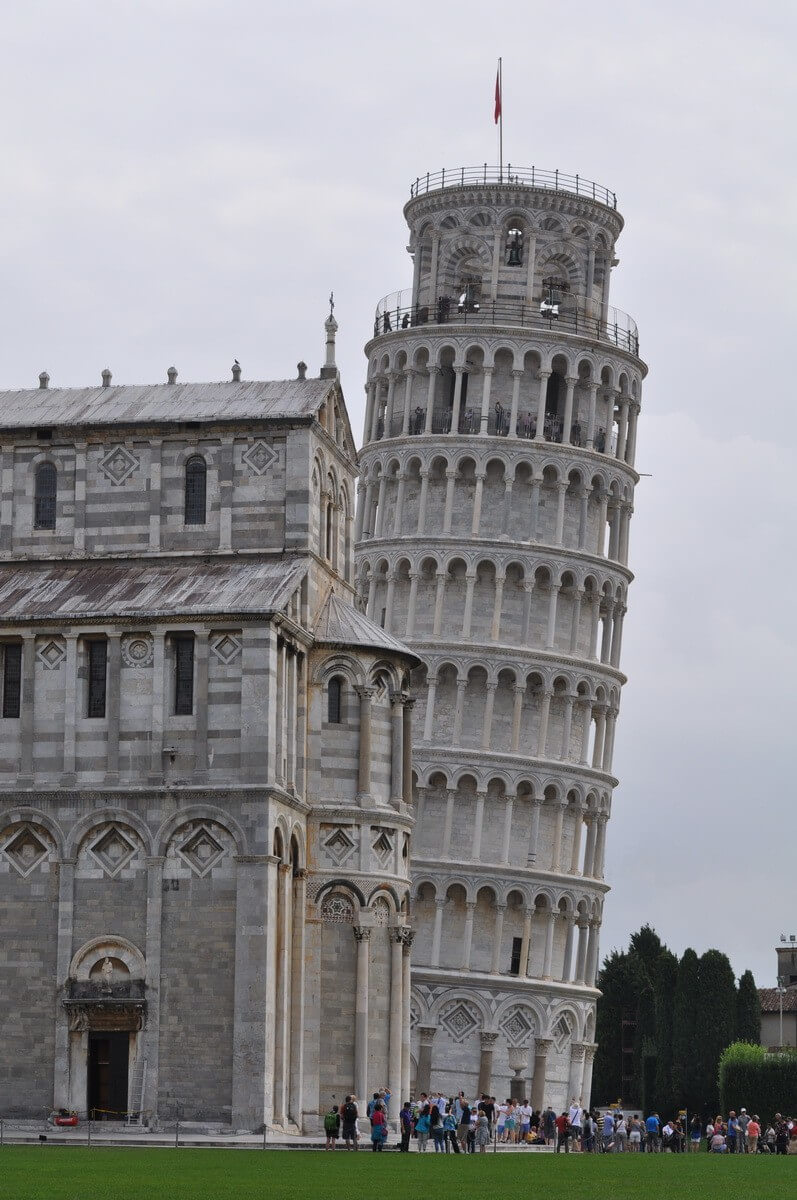
359 km away from the capital of Italy, An ancient city near the Ligurian Sea and on the banks of the River Arno, is Pisa, where a white and gray marble-made magnificent bell tower surprisingly leans with 3.9 degrees drifting 4 meters from vertical toward the south, due to a reason hidden deep in its foundation. But, it is famously known as the Leaning Tower of Pisa and has become one of the top tourist attractions in Europe. Six million visitors come to see this iconic tower every year
So, what’s the unbelievable story behind this leaning? Let’s break it down.
Table of contents
- WHY is the Tower of Pisa Leaning?
- WHY it is built?
- Pisa City Before the Leaning Tower
- Making of the Leaning Tower of Pisa: A Beautiful Mistake
- The Leaning Tower after the construction
- Rescue of the Leaning Tower of Pisa: How the Collapse Was Prevented
- Amazing Facts About the Pisa Tower
- Visit the leaning tower of Pisa, Time, Distance, Ticket price
1. WHY is the Tower of Pisa Leaning?
The Leaning Tower tilts approximately 3.9 degrees to the south.
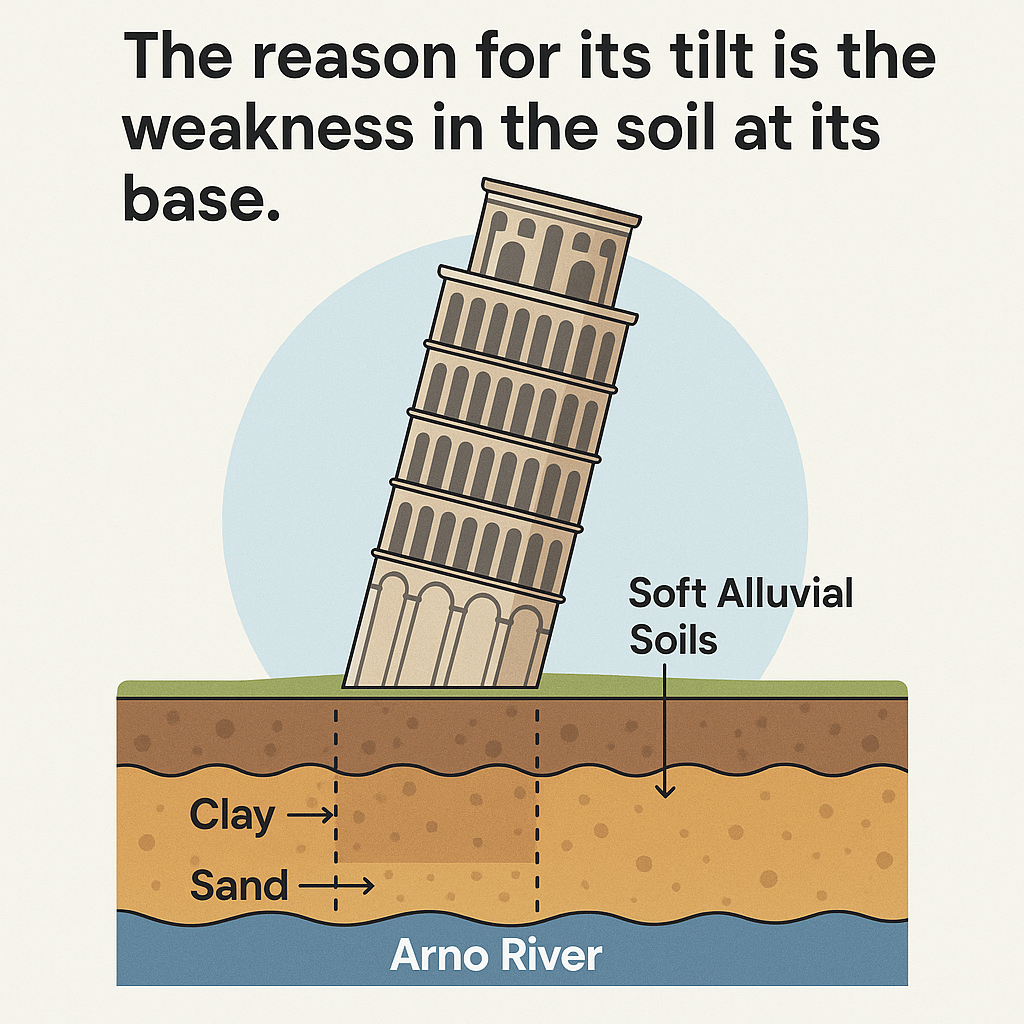
The reason for its tilt is the weakness in the soil at its base. The soil under its base is made up of clay and sand, which are soft alluvial soils ( loose soil left by river water) , brought by the Arno River thousands of years ago. Another reason is that its foundation is very shallow, only about 3 meters deep, which was not enough to support the heavy structure on such soft and unstable soil.
The tower was never meant to be built tilted, but after building the third story, due to the soil being weaker on the south side, it started to tilt. Despite a lot of unsuccessful efforts, it was finally completed with a tilt.
Over time, it kept tilting at a rate of 0.0063 per year for about 850 years, and by the year 1990, it had tilted to 5.5 degrees. Then, after a lot of hard work, its tilt was reduced to 3.9 degrees, which was a very difficult and remarkable mission.
2. WHY it is built?
In the 12th century, the administration of Pisa city decided that a cathedral complex would be built to reflect the city's pride, growing influence, and rich cultural identity, and in it, the cathedral building, baptistery, cemetery, and bell tower were to be built.
That fourth part (bell tower) of the complex was the Leaning Tower, on which seven bells are installed, each tuned to a different musical note.
Before we go into its design and technical details, let’s first read the story of Pisa and how this tower was made over a span of 200 years.
2. Pisa City Before the Leaning Tower
Whatever exists today and the reason behind its form is buried in history. That’s why we’re exploring the Pisa’s city before the iconic Leaning Tower, and what it was originally meant for them.
Founded by the Ligurians, the city of Pisa is now known for its stunning architectural marvels—but it wasn’t always so. From 180 BC, it was a part of the Roman Empire, and in 313 AD, it became a Christian bishopric. During Roman times, Pisa served as a naval base, but by the 11th century, it had grown into a major maritime trade hub, gradually evolving into a prosperous and powerful city.
With power came rivalry, Genoa and Venice rose as Pisa’s strongest competitors. To showcase its strength and wealth, Pisa’s influential leaders decided to build a grand cathedral complex. It was to include four magnificent buildings, with the fourth and final being the bell tower we now know as the world-famous Leaning Tower of Pisa.
3. Making of the Leaning Tower of Pisa: A Beautiful Mistake
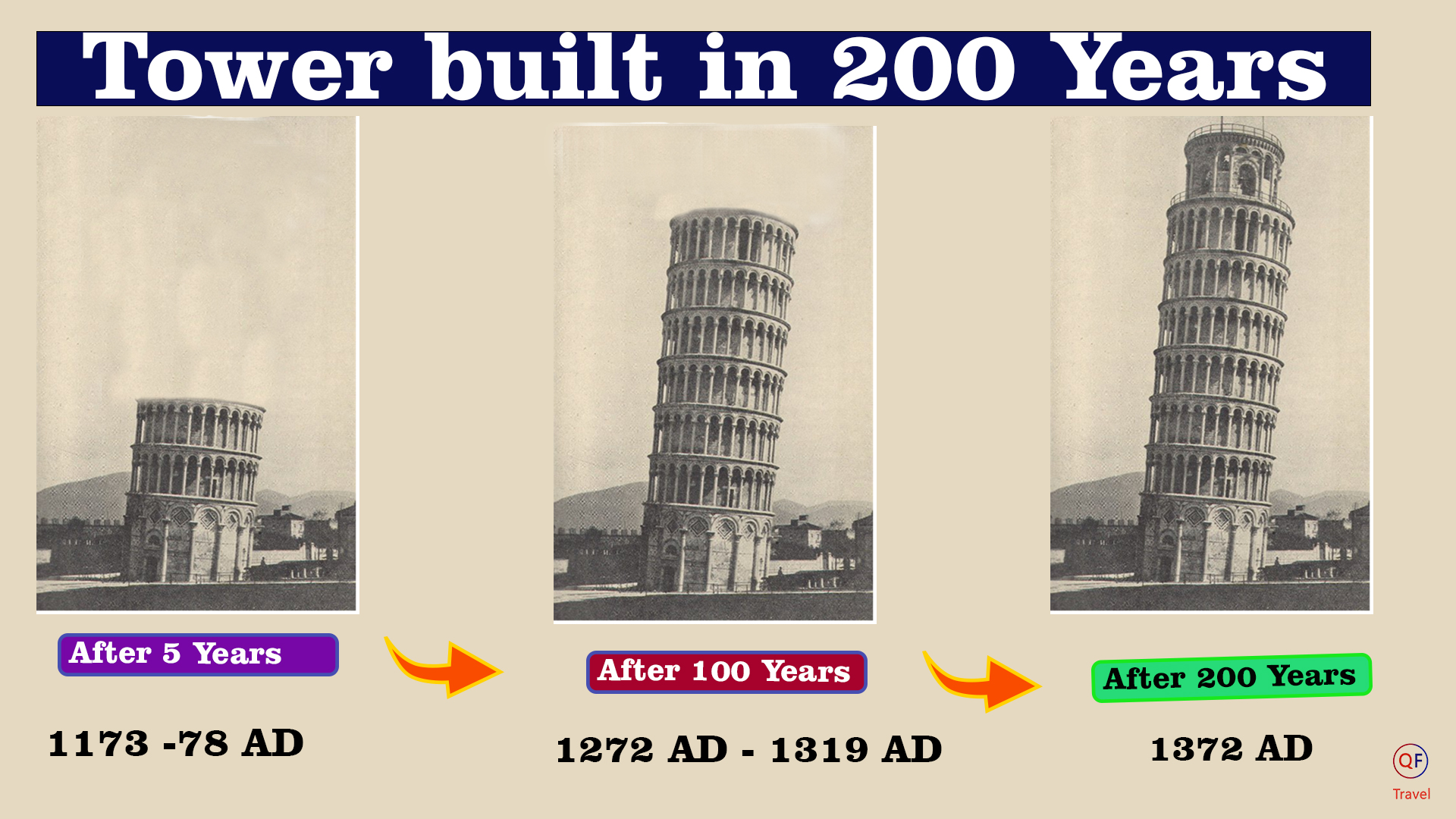
important It took almost 200 years to build this leaning tower, and it was completed in three phases.
Phase 1:
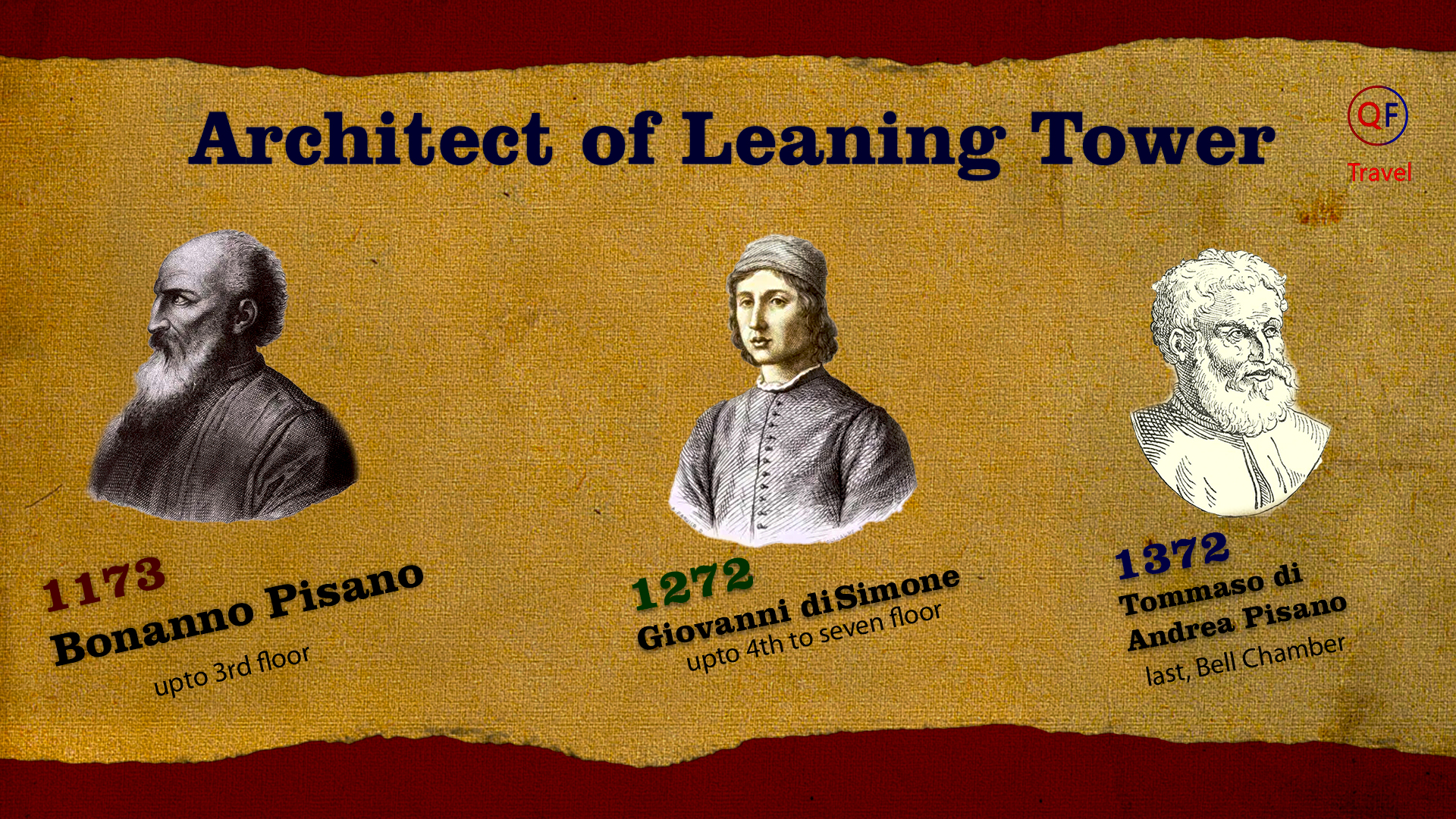
This eight-storey bell tower was planned to be built near the cathedral. under the direction architect Bonanno Pisano, Its construction started in August 1173 AD. After about five years, when the third floor was completed, it began to lean toward the south. This happened because the soil under the base was soft. It had clay and sand, brought by the Arno River thousands of years ago. Around this time, Pisa got involved in a war with nearby cities like Genoa and Florence. Because of this, the construction stopped for nearly a hundred years. During this time, some efforts were made to fix the tilt, but none of them worked.
importantThere’s no record of who first designed the tower, but most believe it was Bonanno Pisano, an Italian sculptor and architect.
Phase 2 :
After about a hundred years, construction started again in 1272 AD under the leadership of Giovanni de Simoni. One good thing that happened during this long gap was that the base had settled. However, the problem of the tower leaning to the south was still there.
To fix this, the engineer made the walls taller on the side where it was leaning, up to the seventh floor. But this idea did not work. Instead, as more weight was added, the tower leaned even more towards the south.
In the meantime, in 1284, Pisa went to war with the Genoese. This battle is known as the Battle of Meloria. Pisa lost the war. After this defeat, the construction work again stopped.
By 1319 AD, the tower had reached up to the seventh floor.
Phase 3:
About 50 years later, the last and final storey was completed in 1372 AD. To reach from the seventh floor to the top, there are four steps on the south side and six on the north side. The south side has two fewer steps. This was done to help reduce the tilt of the tower. the architect of the bell chamber was Tommaso di Andrea Pisano
After the construction was completed, seven bells were added at different times in the upcoming 300 years, which we will learn about later.
Important From all this, the engineer at the beginning made a mistake about the soil under the tower base. Second, the base was placed only 3 meters deep. When the tower started leaning after the third floor, another mistake was made — the engineers increased the height of the wall in the leaning side, which created extra weight, and it tilted more. Because of all these mistakes, whether done knowingly or unknowingly, the Leaning Tower became famous all over the world. In fact, it turned out to be a beautiful mistake.
But the challenges were not over yet. Some were still to come even after the tower was built.
Before we talk about those, let us first understand its design and technical details.
Design and Technical Details
The Leaning Tower is an 8-storey structure built in Romanesque architecture.
ImportantRomanesque is a style of Roman architecture which is popular between 900 and 1200 AD. It is known for its large, round arches above doors and windows.
The tower has a double cylindrical ring design - an inner core ring and an outer ring.
There are about 254 spiral steps between the core and outer wall that take you up to the 7th floor.
It looks like there are 7 levels of hollow rings, keep one on top of another.
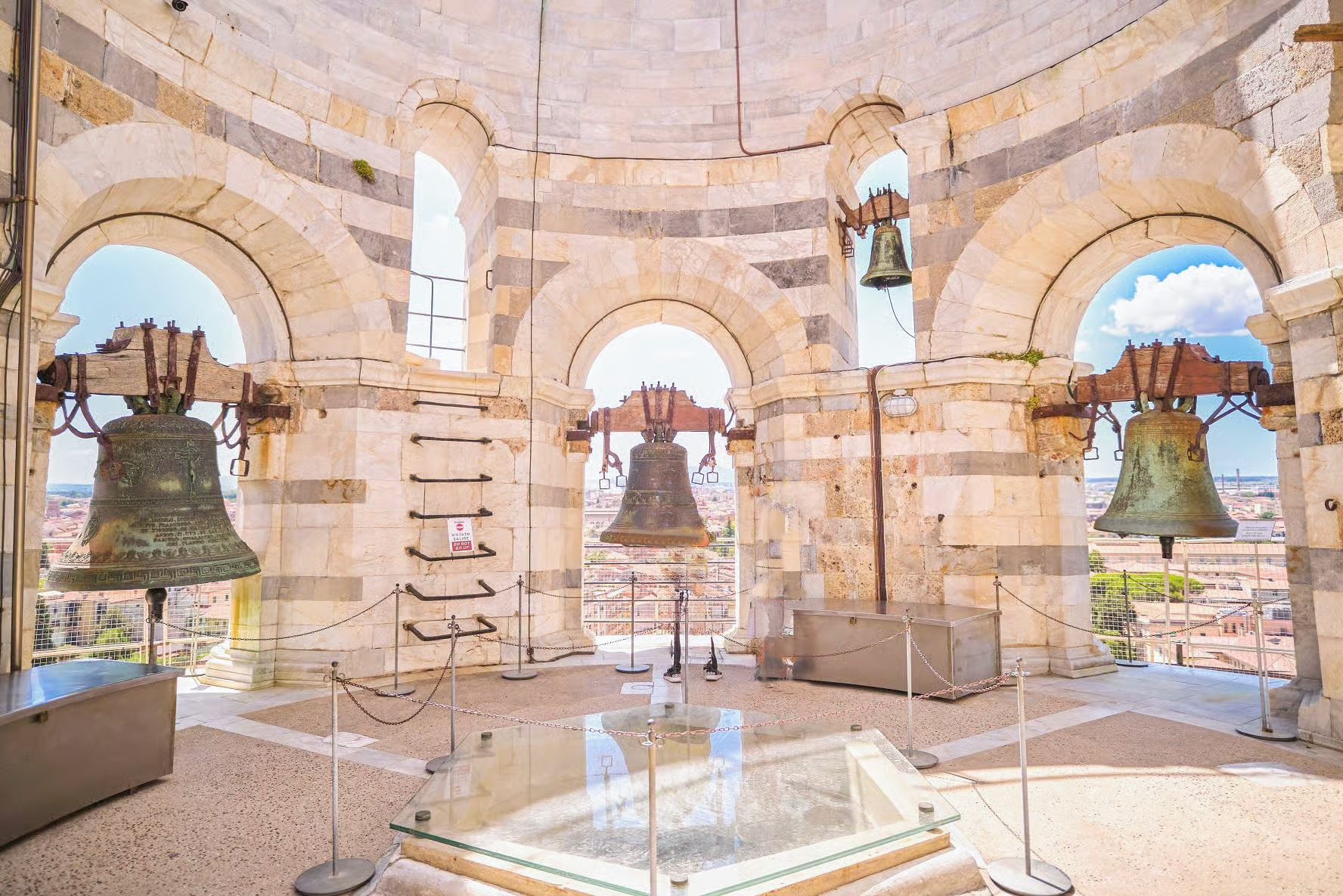
The top floor is called the bell chamber, where the 7 bells are installed.
Width At the base:
- The outer ring’s diameter is about 15.48 meters.
- The outer wall thickness is about 2.4 meters.
- The inner core ring diameter is about 5 meters.
- Its wall thickness is about 1 meter.
- The stairway width is about 1.5 meters.

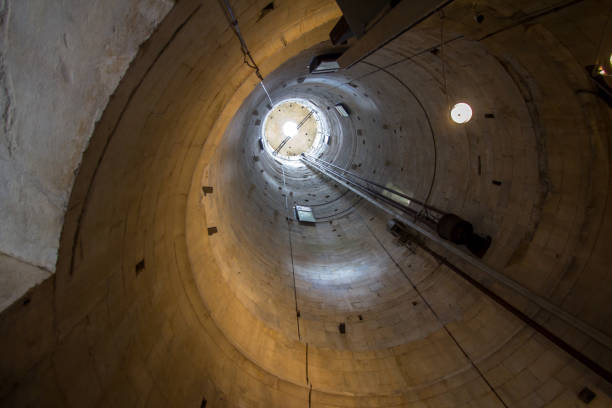
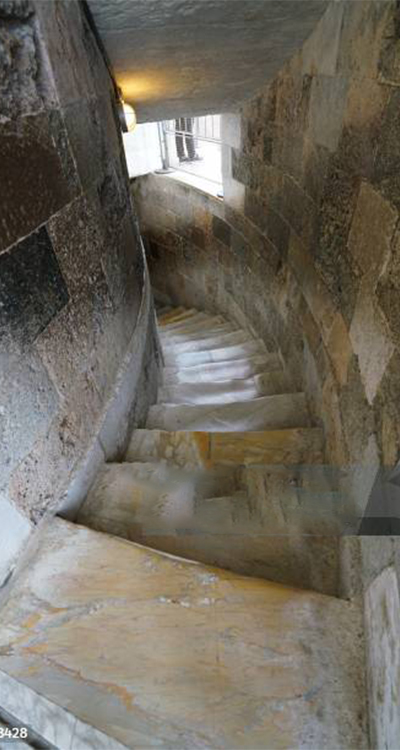
As the tower rises, the outer diameter becomes smaller. This design helps spread the weight equaly so the tower does not collapse.
The inner part of walls are made of limestone, rubble, and mortar (a type of cement), and they are covered with white and grey marble in stripes.
These marble strips Make tower:
- Make the tower look beautiful.
- Also protect the structure from weather.
- The marble layer is 20 to 25 cm thick.
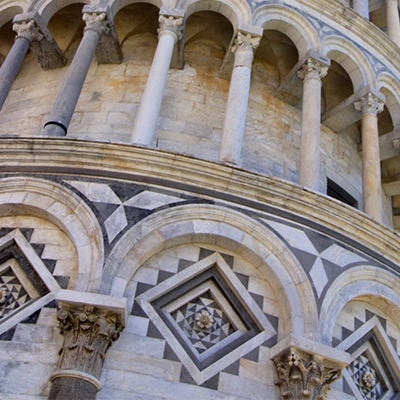
From the 1st to the 7th floor, there are open galleries (walkways) made using columns and arches.
- Each of the 1st to 6th floors has 30 arches.
- The 7th floor has 12 arches.
The columns’ tops (capitals) are carved with flowers, leaves, and geometric shapes.
The striped marble layers around the tower create a rhythm that makes it look elegant.
Near the main door and base, there are stone carvings of Christian symbols, animals, and religious figures.
The top floor, where the bells are installed, has large arches and decorated balconies, giving its a grand look.
The entire tower has about 207 columns and 196 arches.
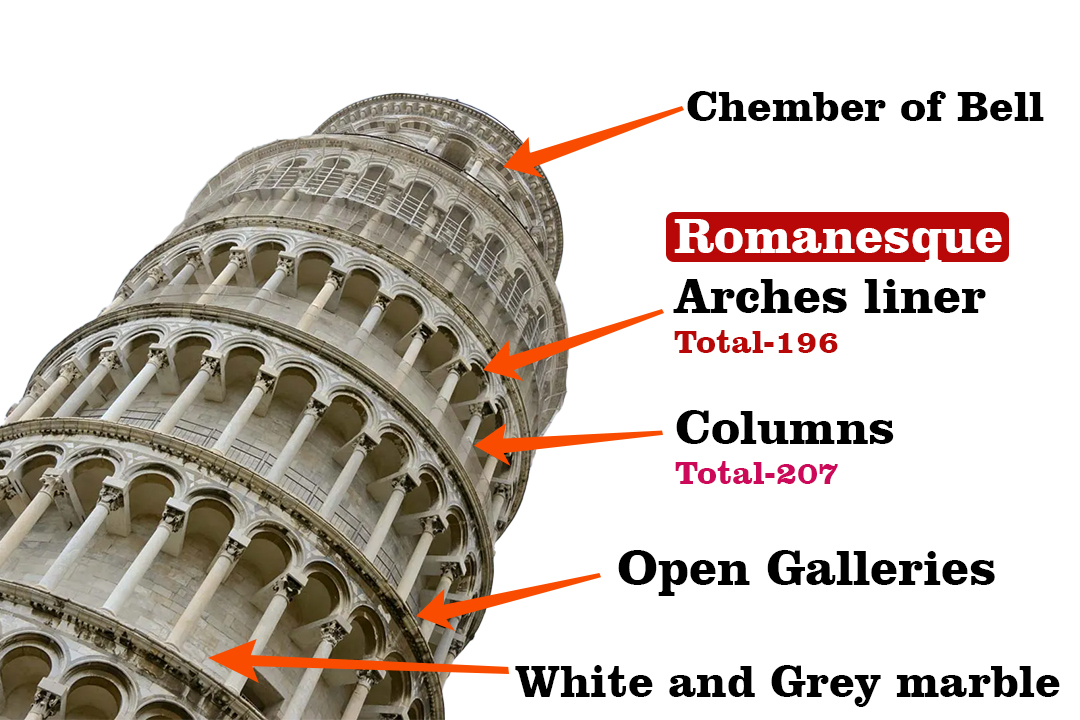
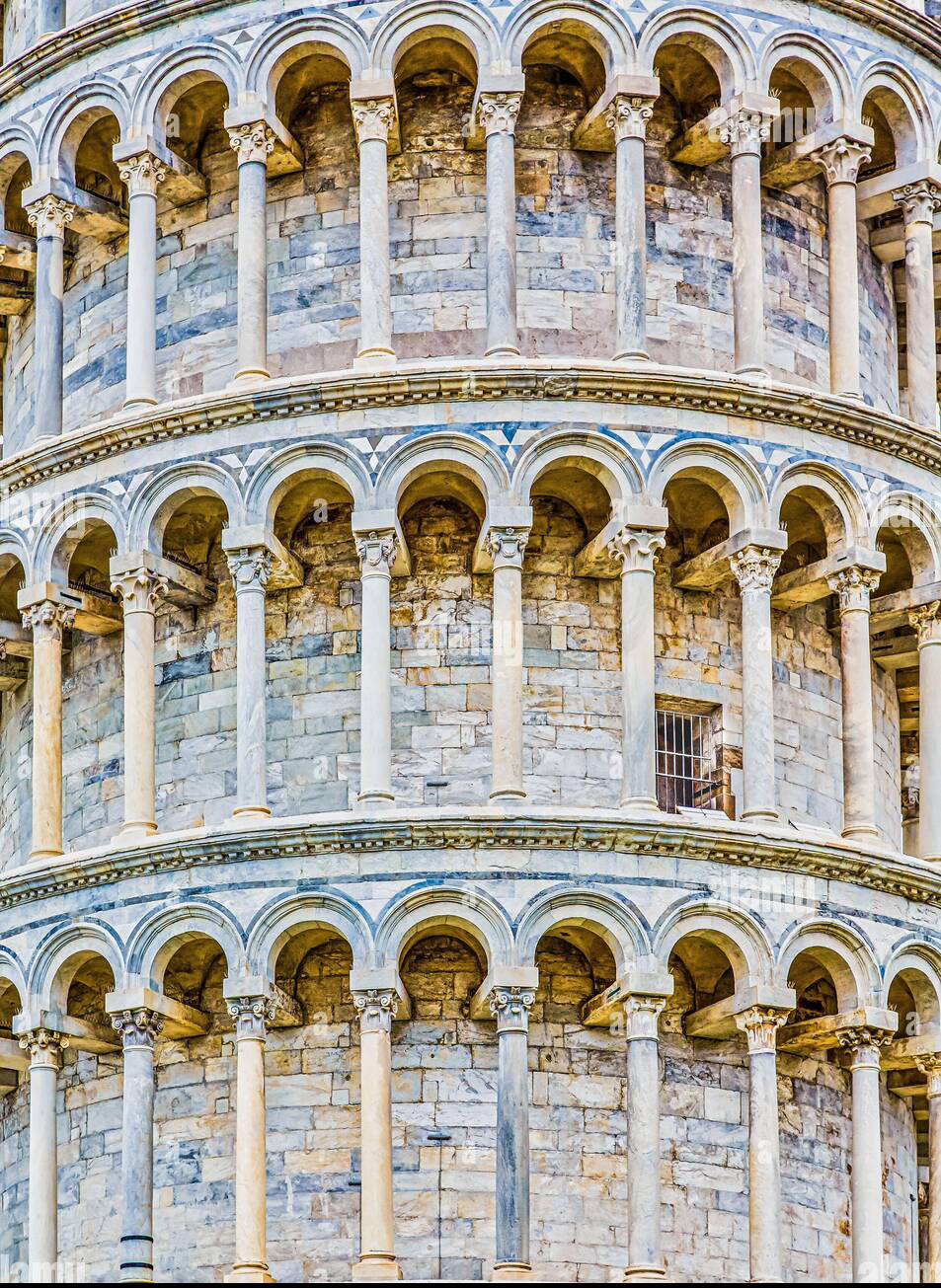
4. Leaning Tower after the construction
Completed around 1372, the Leaning Tower of Pisa took nearly 200 years to build. Even though it leans, the tower has stood strong for over 850 years. What started as a construction flaw became a symbol of architectural brilliance and Italian pride.
But what has happened during all these centuries?
Let’s look at some important moments and hidden stories — from wars and scientific experiments to restoration work and its place as a UNESCO World Heritage Site.
i. Leaning continues over the centuries: Reach the Critical lean 5.4 degrees
When the tower was finished in 1372, no one had measured how much it was leaning. The first measurement was taken in 1817, and it was leaning about 4 degrees. Experts believe that just after it was built, the tilt was around 1.6 degrees. From 1372 to 1800, it leaned about 2 degrees more. Then, between 1800 and 1990, the tilt increased quickly. The total tilt became 5.5 degrees 1990, that is 0.1 degree more than the danger limit of 5.4 degrees. But still, the tower didn’t fall, which was nothing short of a miracle. The reason for not collapsing is unexpected soil behavior and structural resilience.
Learning over time
| Year | Estimated Tilt (in degrees) | Notes |
|---|---|---|
| 1372 | ~1.6° | Construction finished with existing lean |
| 1500 | ~2.0° | Slow increase due to soft foundation |
| 1700 | ~3.0° | Gradual lean continued |
| 1817 | ~4.0° | First official measurements taken |
| 1990 | ~5.5° (Maximum!) | Tower closed to avoid collapse |
| 2001 | ~4.1° | After stabilization |
| 2024 | ~3.97° | Current tilt — fully stable |
Leaning Rate over time in degrees
| Time Period | Degree Change | Tilt Behavior |
|---|---|---|
| 1372–1800s | Slow (~+2°) | Gradual leaning |
| 1800s–1990 | Faster (~+2°) | Dangerous tilt |
| 1990–2001 | -1.5° approx. | Stabilized by engineers |
| 2001–2024 | 0° change | Fully stable |
So, from above we can calculate the average rate of yearly leaning in degrees in 1990 over 850 years
Total increase: 5.5° – 1.6° = 3.9°
Average lean per year ≈ 0.0063 degrees/year (around 1.1 mm at the top)
ii. Bell Installation at Bell Chember
Over the next 300 years, a total of seven bells were installed on the top floor, called the bell chamber. These seven bells played the seven musical notes from A to G.
The ringing of these bells caused vibrations in the tower, which increased the risk of the tower to tilt, so in 1900 it was made completely stationary.
| Bell Name | Note (Musical) | Approx. Weight | Installed |
|---|---|---|---|
| L’Assunta | E | ~3,620 kg | ~1655 |
| Il Crocifisso | C | ~2,462 kg | 1570s |
| San Ranieri | D | ~1,450 kg | 1719 |
| La Terza | F | ~1,000 kg | 1600s |
| La Pasquereccia | G | ~1,014 kg | Oldest bell (1100s, reused) |
| Il Vespruccio | A | ~800 kg | 1600s |
| Dal Pozzo | B | ~650 kg | 1600s–1700s |
iii. World War II – Escape from destruction (1944 AD)
The Allied Forces suspected German snipers were hiding in the tower.
An American sergeant was ordered to bomb the tower but was so struck by its beauty that he refused to carry out the order.
This moment is believed to have saved the tower from destruction.
iV. UNESCO World Heritage Site (1987)
In 1987, the Leaning Tower — along with the entire Piazza dei Miracoli (Square of Miracles) — was designated a UNESCO World Heritage Site.
5. Rescue of the Leaning Tower of Pisa: When It Nearly Collapsed
Tower iconic tilt makes it special in the world. But do you know that there was a time when this tower was on the verge of falling?
With an average tilt of 0.0063 degrees every year since 1372, it tilted up to 5.5 degrees in 1990 but it did not fall, which was a miracle, but the possibility of its collapse had increased.
A year before this, on March 17 1989, the Civic Tower of Pavia, italy collapsed. Tragically, four people died in the collapse. Then in 1990, Leaning Tower was closed to the public and major stabilization work began. The Italian government formed a committee to save it.
The committee of experts formed to save the Leaning Tower of Pisa from falling was named:
"International Committee for the Safeguard of the Tower of Pisa"
This committee was formed by the Italian government in 1990, and included world-renowned engineers, architects, geologists, and conservation experts. It was headed by Professor Michele Jamiolkowski, who was a geotechnical expert.
Some prominent names in this committee:
- Prof. Michele Jamiolkowski – Geotechnical engineer (Chairman)
- John Burland – British civil engineer, who implemented the soil removal technique
- Piero Pierotti – architectural historian
This committee worked from 1990 to 2001 and the tower was successfully stabilized. This is one of the most tedious but successful engineering conservation projects ever.
How do they Save It?
First, engineers placed 600 metric tons of lead on the opposite side of the lean to balance the tower.
They also tied the tower with strong anchor cables in both directions to keep it safe.
Soil Evacuation
Engineers are studied the soil under the tower. They made a small model like the Leaning Tower to test how the soil behaves. They found that if they removed some soil from the north side (the side opposite the lean), the tower would slowly tilt back in the other direction.
They tried this for the tower, and it worked. Engineers carefully removed about 70 metric tons of soil using precision drilling machines. by 2006 tower tilted back 5.5 to 3.9 degrees, and it is safe for the next 300 years.
The story of saving the Leaning Tower of Pisa is not just about a tower, but about culture, heritage and engineering wonders.

If it had not been saved, the world would have been deprived of a wonder today.
The Leaning Tower not straightened fully because
- the world knows the Leaning Tower of Pisa because it is tilted. If it had been straightened completely, its unique identity would have been lost.
- This tilt is what makes it a World Heritage Site (UNESCO World Heritage Site) and attracts millions of tourists.
- The tower is very old (12th century) and its foundation is weak If it were straightened suddenly or completely, it would put unnecessary pressure on the stones and the support structure could even break or damage the staircases and architectural designs inside
So the engineers decided to straighten it just enough to make it safe, but keep its historic tilt.
6. Amazing Facts About Pisa Tower
1. Tilt Rate of 0.0067° per Year
After its completion, the tower continued tilting rate average 0.0067° per year.
2. Tilt stabilized at 3.9° by 2008
Restoration efforts reduced the tilt to about 3.9°, and since 2008, the tower has remained stable. And the engineer say it is stable and safe for the next 300 tears
3. Galileo’s Gravity Experiment
Famous Italian scientist Galileo Galilei was born in Pisa. Galilei dropped two spheres of different weights from the top of the bell chamber at tower to prove that objects fall at the same rate regardless of mass.
4. Pisa Lost Sea Harbor in the 16th Century Due to the Arno Delta
As the Arno River shifted and built up silt, Pisa lost its harbour by the 16th century, leading to its decline as a maritime power
5. Computer Model with Sensors in 1990 Restoration
During the 1990–2001 restoration, engineers used sensors and computer modeling to monitor and reduce the tilt by removing soil and adding counterweights
6. €20–30 Million Restoration Cost
The restoration project of tower is very costly. the project cost was about €20 to €30 million
7. Seven Bells Tuned from A to G
There are 7 bells, one for each major scale note A–G. The largest weighs nearly 8,000 lb, and they haven’t been rung since the 20th century to avoid unsettling the structure
7. Visit the leaning tower of Pisa, Time, Distance, Ticket price
Where is the Leaning Tower of Pisa?
The Leaning Tower of Pisa is located in the city of Pisa, in the Tuscany region of Italy. It is a historic bell tower that is world famous because of its tilted structure. The tower is part of the Piazza dei Miracoli (Square of Miracles), where you will also find the Cathedral, Baptistery, and Museum.
Leaning Tower Visiting Hours
The visiting time of the Leaning Tower depends on the season.
- From April to September, it is open from 9:00 AM to 8:00 PM.
- From October to March, it is open from 9:00 AM to 6:00 PM
- The last entry is allowed 30 minutes before closing time.
Ticket Price
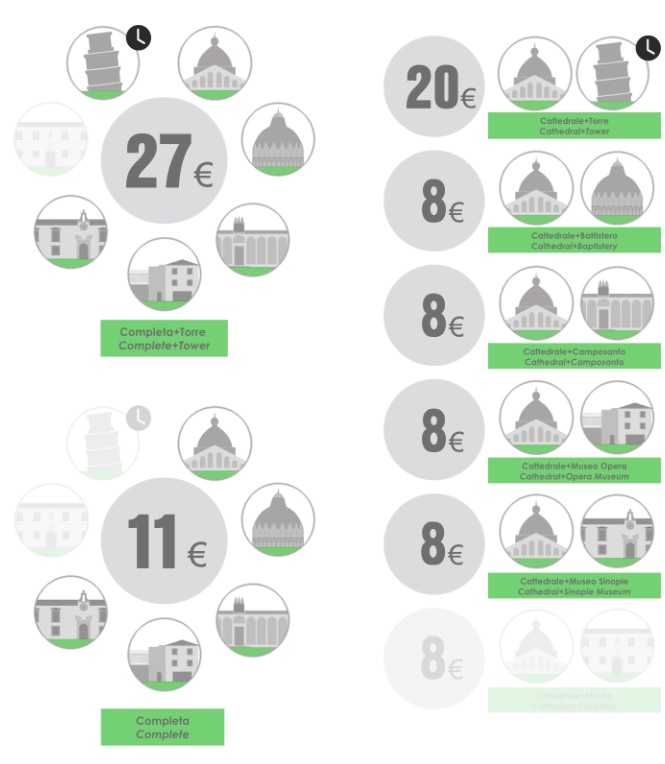
The ticket price for the tower visit is €20, If you want to visit the tower along with the Cathedral and Museum, there is a combo ticket available for €27.
importantEntry to the Cathedral only is free, and no ticket is needed. Children under 8 years are not allowed to climb the tower for safety reasons.
You can book tickets online at: www.opapisa.it
How to Reach Pisa?
If you are traveling by train, Pisa is easy to reach.
From Florence, the distance is about 85 km, and it takes around 1 hour.
From Rome, the distance is about 350 km, and the journey takes around 2.5 to 3 hours.
By air, you can fly to Pisa International Airport (PSA), which is just 6 km away from the tower.
For local travel, you can either walk 20 minutes from Pisa Centrale Station or take the LAM Rossa Line local bus.
Travel Tips for the Leaning Tower of Pisa
Book your tickets online in advance to avoid waiting.
Bags are not allowed inside the tower, but lockers are available.
Be prepared to climb 294 steps to reach the top of the tower.
The area around the tower and the top both offer excellent spots for photography.
If visiting in summer, it is better to go early in the morning to avoid heavy crowds.